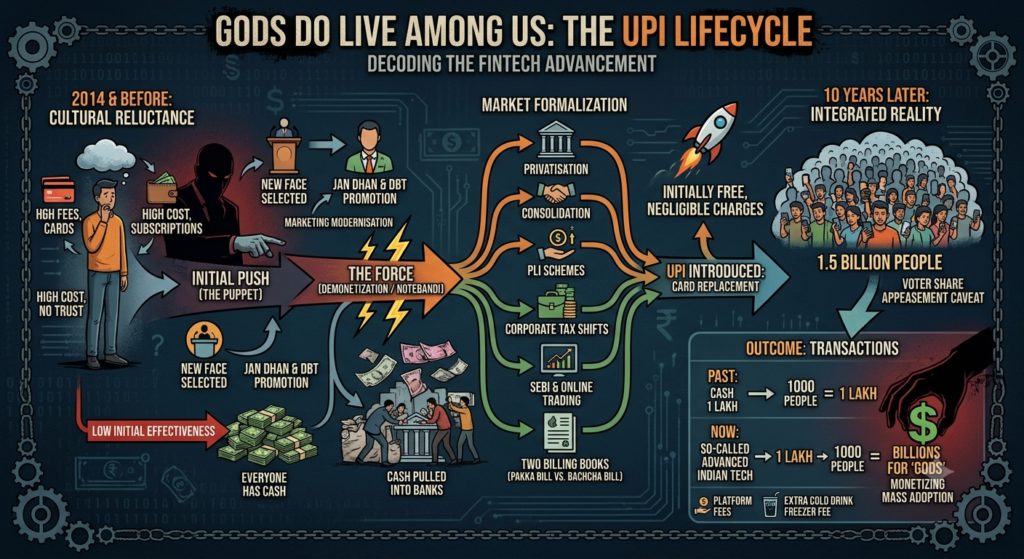
Gods do live among us.
I had to write this because a fintech founder said UPI is “Indian tech. Advancement
Economy is really fascinating—let’s look at the lifecycle of UPI. It’s not just about that 0.04% charge.
If you had asked anyone in 2014 to use a card for payment, they wouldn’t have gone through with it because of the high card subscription charges for a country which have uneducated 1.5 billion people.
So, the Gods wanted a puppet to steer the flock of sheep.
It all started with black money. When people wanted a new face, a puppet got selected.
That puppet started Jan Dhan accounts and Direct Benefit Transfers to promote digital payments, making banking the new face of modernisation.
However, this push wasn’t effective initially because everyone still held their money in cash.
Then came the push for demonetisation (Notebandi). It pulled all the cash out of circulation and forced it into the banks.
Next came:
- Privatisation of banks
- Consolidation/Unification of banks
- PLI schemes
- Corporate tax shifts and PF integration
- SEBI reforms and the push for online trading
After all this, it became easy for them to introduce UPI as a card replacement—initially free, with negligible charges.
Fast forward 10 years, and UPI has become an integral part of life for 1.5 billion people. Introducing charges now isn’t a problem, provided there is a small caveat to appease the 51% needed for a vote bank.
This is a country that pays platform fees for basic delivery orders. A country where people pay extra for a cold drink just because it was kept in a freezer.
A country keeps two billing books pakka bill (with GST) or bachcha bill (Without GST)
The ultimate outcome Transaction charges: if you transferred 1 lakh in cash to a thousand people in the past, it remained just 1 lakh. Now, transferring that same money through this so-called “advanced Indian tech” allows those Gods to make billions every year.